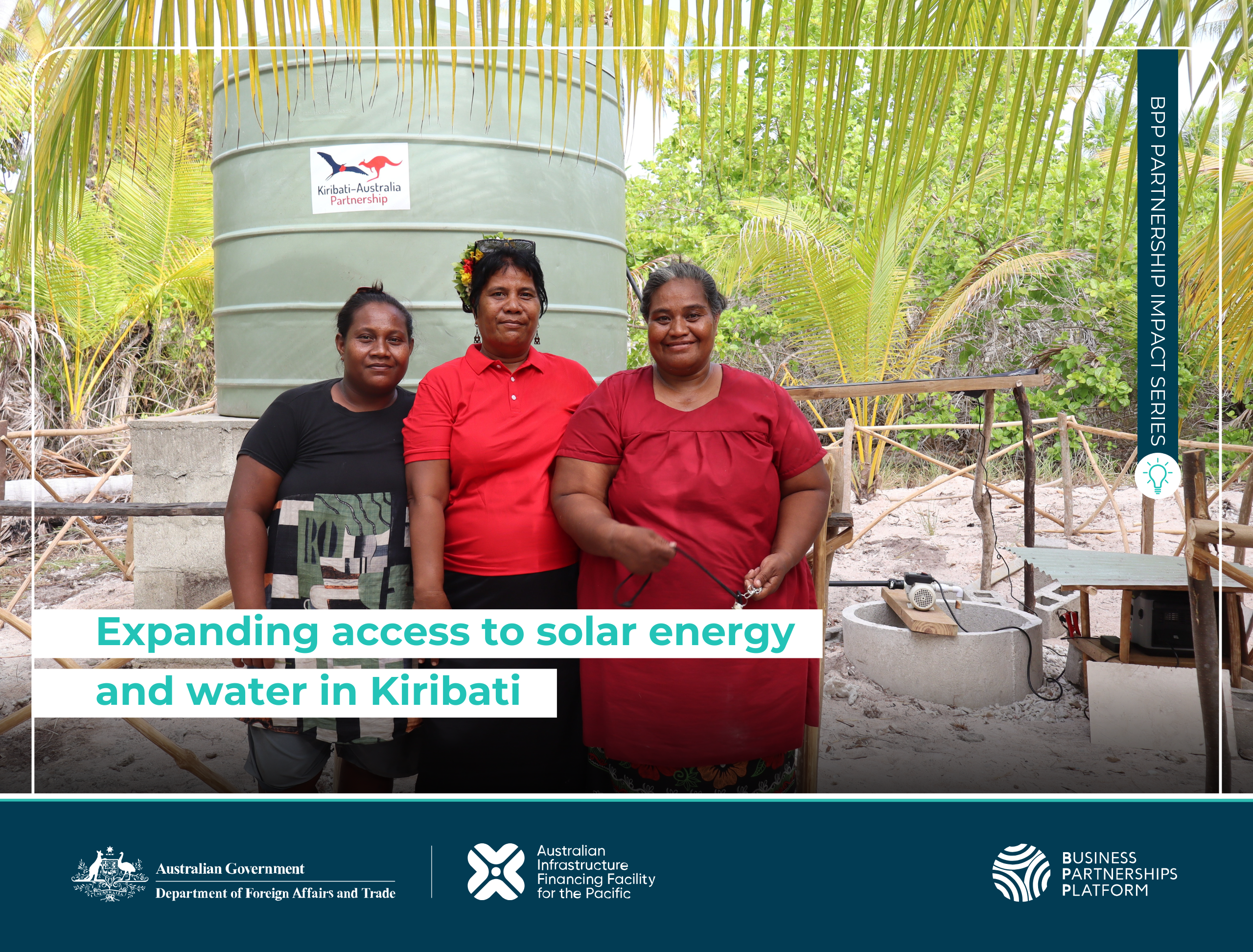
BPP Partnership Impact Series: Expanding access to solar energy and water in Kiribati
Since its launch, the Business Partnerships Platform (BPP) has worked with ambitious partners to deliver meaningful, lasting change in communities across the world. The BPP Partnership Impact Series celebrates the outcomes and lessons from our partnerships, highlighting their contributions to inclusive economic growth, resilience and sustainable development.
Our Off-Grid Renewable Energy partnerships across the Pacific and Timor-Leste focused on sustainable, locally-led solutions that expand energy access for remote and rural communities, while delivering tangible social and economic benefits. They are pilots for REnew Pacific, the Australian Infrastructure Financing Facility for the Pacific’s (AIFFP) $75 million investment to scale off-grid renewable energy across the region. This partnership installed solar-powered battery systems and solar water pumps, bringing reliable energy and safe water to more than 1,000 people on Aranuka Island in Kiribati, and established women-led management committees to ensure long-term sustainability for the local communities.
Expanding access to solar energy and water in Kiribati
The partnership between Action on Poverty, the Foundation for the Peoples of the South Pacific Kiribati (FSPK), PowerTech Energy and the Australian Government, through the Business Partnerships Platform (BPP), is improving access to reliable renewable energy and water in remote communities in Kiribati.
Delivered on Aranuka Island, the project has installed solar-powered systems across community infrastructure, providing sustainable access to electricity and safe water for the entire population.
Solar systems have been installed at community halls, schools and freshwater wells, enabling essential services and supporting daily life in remote island communities.
Impact key highlights
- 1,057 people benefiting from improved energy and water access
- 214 households accessing improved community infrastructure
- 6 solar-powered wells improving access to safe drinking water
- 5 community halls and 1 school site with reliable electricity
- Approximately 7,200 litres of diesel displaced annually
- Around 19 tonnes of CO₂ emissions avoided each year
Delivery snapshot
- 12 solar systems installed across community infrastructure
- 11.96 kW total solar PV capacity
- ~39 kWh total battery storage
- Solar pumps installed on six wells, supplying water to 5,000L tanks
- Modular, pre-engineered systems enabling local installation
Reliable solar energy is improving access to both water and essential community services. Solar-powered wells now provide accessible water through multiple tap points, reducing the time and physical effort required to collect water.
Community halls (maneabas) are now powered for evening use, supporting cultural events, church services and community gatherings. Access to lighting and power has increased activity in shared spaces, strengthening community connection and participation.
At Kauke Primary and Junior Schools, solar power is enabling improved learning conditions, with lighting, internet access and device charging supporting both students and teachers. Schools are now able to run evening study sessions and expand learning opportunities.
The project has also contributed to reduced reliance on diesel generators, lowering fuel costs while increasing fuel availability for essential activities such as fishing.
A key feature of the project is its locally led delivery model. Solar systems were installed by FSPK, an Island Council Electrician and community volunteers, supported by remote based technical guidance. This approach has built local capacity while fostering strong community ownership.
The project has also supported greater inclusion and leadership for women. Five Infrastructure Management Committees were established, with women in executive roles. Women are actively managing the systems and making decisions about their use.
The project demonstrates a practical and scalable model for delivering renewable energy in remote island contexts. By combining local implementation, modular system design and community governance, the approach enables sustainable operation and maintenance beyond the life of the project.
Community-led management, supported by small user levies, is helping to fund ongoing maintenance and ensure long-term system performance. Building on this success, the model shows strong potential for replication across other outer islands in Kiribati and similar Pacific contexts, with further projects already being explored.
View the full partnership impact story below or download here.