
BPP Partnership Impact Series: Lighting the way for Kokoda College’s sustainable future in Papua New Guinea
Since its launch, the Business Partnerships Platform (BPP) has worked with ambitious partners to deliver meaningful, lasting change in communities across the world. The BPP Partnership Impact Series celebrates the outcomes and lessons from our partnerships, highlighting their contributions to inclusive economic growth, resilience and sustainable development.
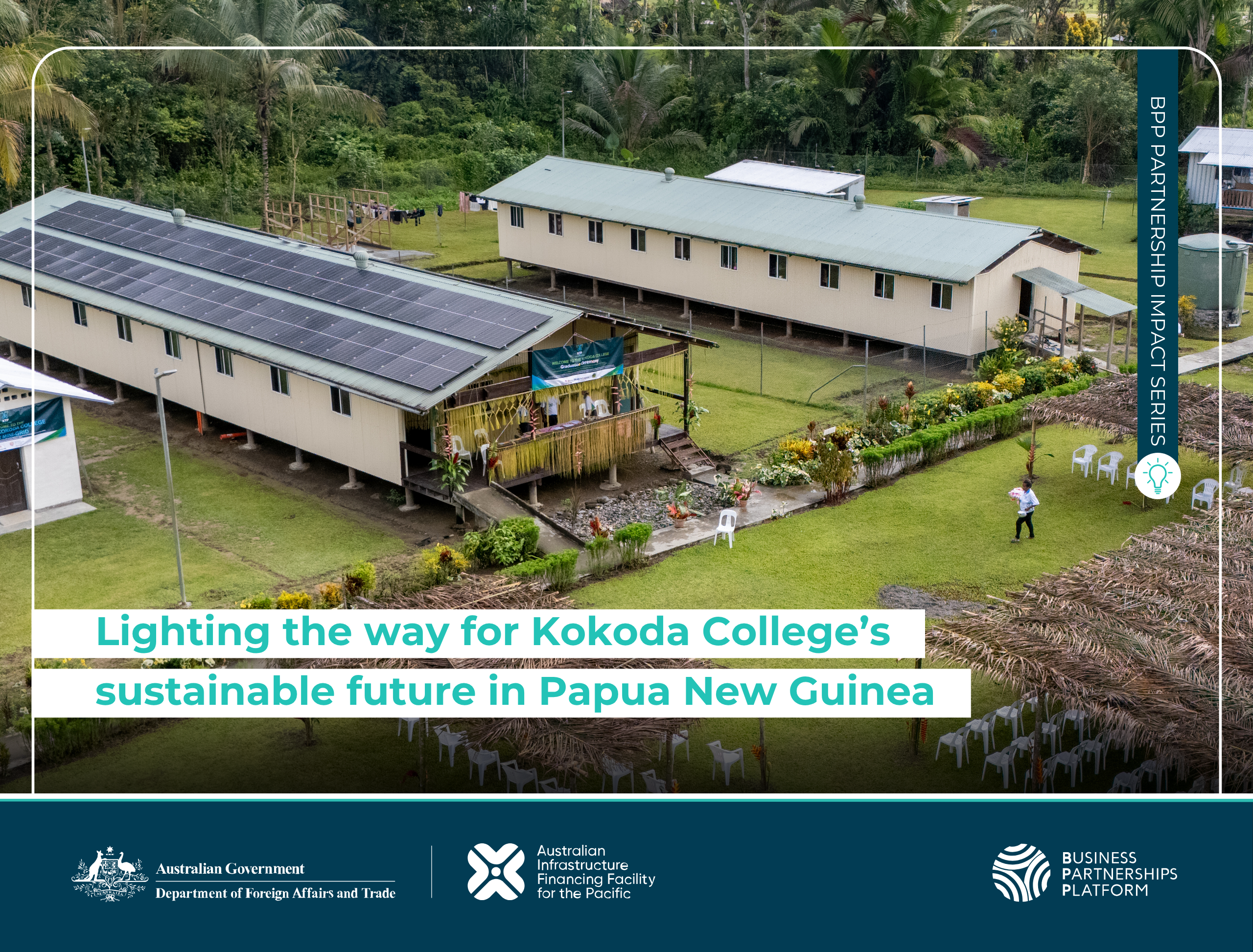
Our Off-Grid Renewable Energy partnerships across the Pacific and Timor-Leste focused on sustainable, locally-led solutions that expand energy access for remote and rural communities, while delivering tangible social and economic benefits. They are pilots for REnew Pacific, the Australian Infrastructure Financing Facility for the Pacific’s (AIFFP) $75 million investment to scale off-grid renewable energy across the region. This partnership installed a solar mini-grid at a remote college in Papua New Guinea, strengthening learning outcomes and contributing to greater health and safety for both students and staff.
Lighting the way for Kokoda College’s sustainable future in Papua New Guinea
A partnership between the Kokoda Track Foundation (KTF) and the Australian Government, through the Business Partnerships Platform (BPP), is transforming education and community wellbeing at Kokoda College in Papua New Guinea.
Located in Oro Province along the Kokoda Track, the college operates in a highly remote and climate-exposed environment, where unreliable electricity has long limited teaching, learning, safety and access to essential services. These challenges have disproportionately impacted women and students with disabilities.
Through this partnership, a first-of-its-kind solar mini-grid has been installed – delivering reliable, campus-wide electricity and demonstrating how off-grid renewable energy can support inclusive education, improve health and safety, and strengthen climate-resilient infrastructure in remote communities.
For many students and staff, this is the first time they have experienced consistent electricity. Today, classrooms, dormitories and staff housing are powered 24/7 – enabling students to study at night, charge devices and participate more fully in learning, while improving overall wellbeing across the college community.
Key highlights
Highlights from the BPP partnership included:
- 308 people benefiting from clean, reliable energy, including 193 students (51% women, 23 students with disabilities) and 109 staff
- First-time access to consistent, reliable electricity for many students and staff
- 24/7 clean power across the campus, replacing limited and weather-dependent supply
- Approximately 500 litres of diesel saved annually
- Measurable improvements in learning outcomes, safety, health and inclusion.
Delivery snapshot
- 36 kW solar mini-grid with battery storage enabling campus-wide electrification across classrooms, dormitories and staff housing
- IT lab established with assistive technologies
- Solar-powered water bore, pump and filtration system installed
- Disability-accessible ablution block and upgraded pathways delivered
- Electric incinerator commissioned for improved waste management
- Seedling nursery established for food security and hands-on learning
Reliable electricity has transformed daily life and learning. Students now have more time and support to study, with evening reading increasing by 47% and homework time by 21%. Nearly all students report improved ability to charge devices and study at night, with 100% feeling more supported to complete their studies.
Inclusion has been central to the project’s design and delivery. Students with disabilities now benefit from accessible infrastructure and assistive technologies, with enjoyment of campus increasing significantly. Women’s sense of safety has also improved, enabling greater access to facilities and study spaces after dark.
The project also demonstrates a sustainable and scalable model for remote contexts. Staff have been trained to operate and maintain the system, supported by clear protocols, funding for ongoing maintenance, and remote technical support. This locally owned approach ensures long-term reliability and strengthens capacity within the community.
While delivering in Kokoda’s remote and logistically complex environment presented challenges, strong local coordination and a focus on capacity building have ensured successful implementation and long-term sustainability.
Building on its success, the model is now being scaled to new sites in Papua New Guinea, including a health facility in Oro Province and a secondary school along the Kokoda Track through REnew Pacific.being embedded into ongoing service delivery, supporting long-term customer use and system performance.
View the full partnership impact story below or download here.

