
BPP Partnership Impact Series: Community-led hydro upgrade delivers reliable energy in Solomon Islands
Since its launch, the Business Partnerships Platform (BPP) has worked with ambitious partners to deliver meaningful, lasting change in communities across the world. The BPP Partnership Impact Series celebrates the outcomes and lessons from our partnerships, highlighting their contributions to inclusive economic growth, resilience and sustainable development.
Our Off-Grid Renewable Energy partnerships across the Pacific and Timor-Leste focused on sustainable, locally-led solutions that expand energy access for remote and rural communities, while delivering tangible social and economic benefits. They are pilots for REnew Pacific, the Australian Infrastructure Financing Facility for the Pacific’s (AIFFP) $75 million investment to scale off-grid renewable energy across the region. This partnership upgraded existing energy infrastructure to significantly expand capacity and distribution, delivering reliable, affordable electricity across Vavanga, improving livelihoods and creating new opportunities for local businesses.
Community-led hydro upgrade delivers reliable energy in Solomon Islands
An upgraded community-owned micro-hydroelectric system has been completed in Vavanga, Western Province, Solomon Islands, delivering reliable, affordable electricity to households and key community facilities.
Supported by the Australian Government through the Business Partnerships Platform (BPP) and delivered in partnership with Pelena Energy, the project strengthens local energy access, enables new income-generating opportunities, and builds long-term climate resilience in a remote island community.
For more than 30 years, Vavanga has managed its own micro-hydro system. But the original wiring, installed in 1993, was designed to power only a small number of homes and basic lighting. This limited the community’s ability to expand local businesses and improve livelihoods.
Today, that is changing. The upgraded system combines community-owned hydro generation with a new electrical reticulation network, delivering affordable, grid-level reliable electricity to all 116 households. Community facilities including schools, churches and meeting halls will also benefit from consistent power.
Impact key highlights
- 116 households and key community infrastructure, including schools, churches and meeting halls, have access to affordable, reliable electricity expanding essential services
- 47 streetlights powered, improving safety after dark
- Energy access now supports freezer storage, ice production and copra drying, unlocking local economic opportunities
- Increased women’s participation in managing and maintaining energy-linked infrastructure.
Delivery snapshot
- 8kW community-owned micro-hydropower energy system
- Safe, higher-capacity electricity with significantly increased distribution to benefit the entire village
- Flexible tariff model (cash or coconuts) improves affordability and access for all households
- Strong community ownership, led by the long-standing Vavanga Hydro Committee with expanded roles.
The project unlocks new economic opportunities for Vavanga. Reliable electricity will support a freezer room and ice production, improving food storage and fisheries income, as well as dehumidifiers for copra drying to strengthen agricultural productivity.
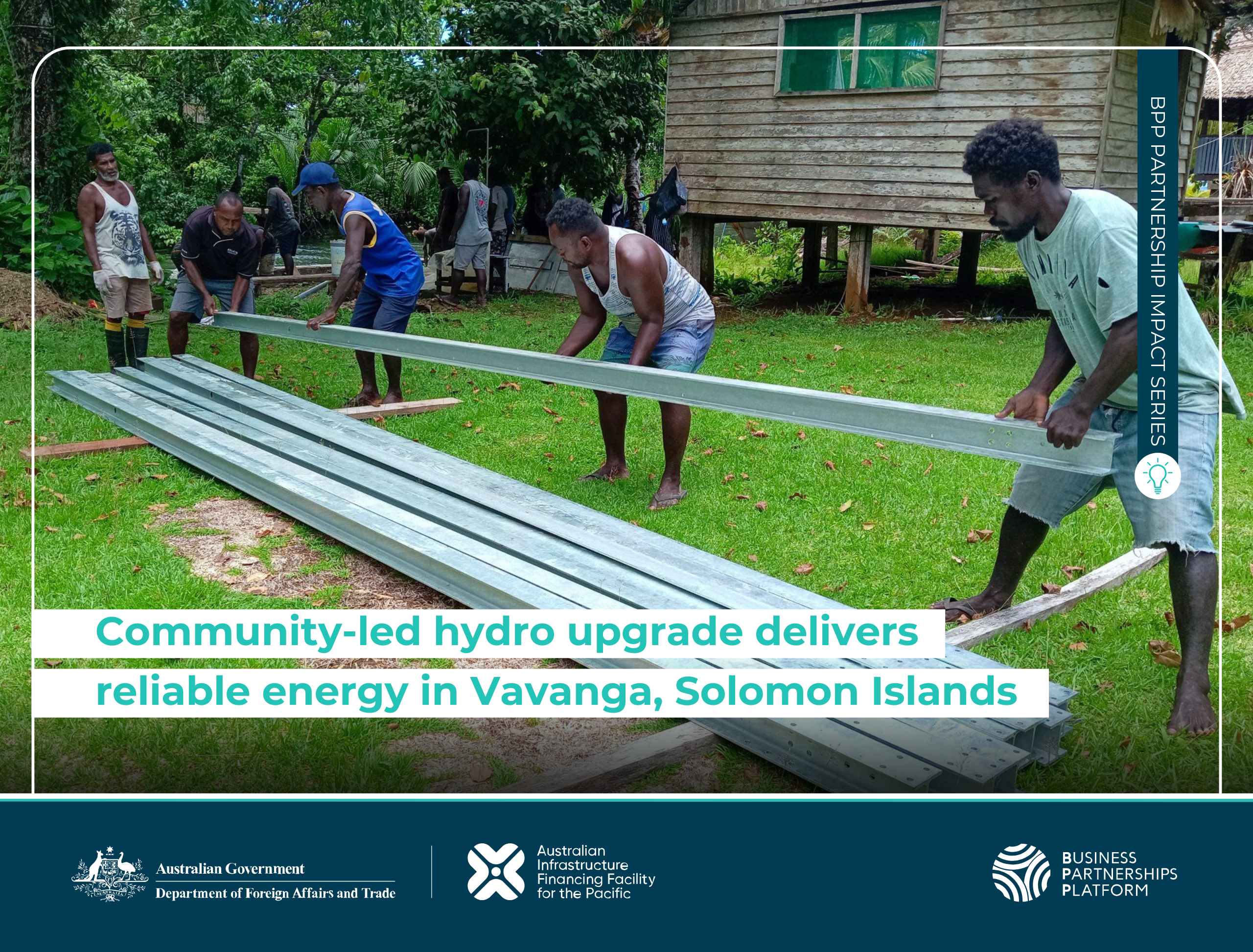
The project reflects a strong collaboration between local leadership and technical expertise. Equipment was manufactured in Dorrigo, Australia, before being shipped to Solomon Islands and transported to Vavanga by community members using fibreglass boats demonstrating the community’s ownership and commitment.
The project builds on existing local governance systems. The Vavanga Hydro Committee, which has managed the system since the 1990s, will continue overseeing operations, with expanded responsibilities for metering and tariff collection. Payments can now be made based on electricity usage, with flexible options including cash or coconuts, ensuring access for all community members.
Women are also playing a central role. The local women’s group will lead operation and maintenance of the freezer and drying facilities, creating new opportunities for leadership and economic participation.
View the full partnership impact story below or download here.

